Maintaining Nutritional and Exercise Adequacy During GLP-1–Based Weight Loss
A Digital Monitoring Approach to Protein, Nutrient Intake, Physical Activity, and Early Intervention
Abstract
GLP-1 receptor agonists and related incretin-based therapies have substantially changed the treatment of obesity by producing clinically meaningful and often substantial weight loss. Their effectiveness is driven in part by reduced appetite and spontaneous reductions in energy intake. However, reduced food consumption can also reduce protein, vitamin, mineral, and other nutrient intake. In addition, substantial weight loss generally includes loss of both fat mass and some lean tissue.
These observations create a practical clinical problem. Patients receiving GLP-1–based therapy may be given recommendations regarding protein intake, diet quality, physical activity, and resistance exercise, but adherence to these recommendations is difficult to determine between clinical encounters. Patients themselves may have difficulty knowing whether their cumulative intake over days or weeks meets nutritional targets.
A digital monitoring approach may help close this gap. HE-Food is designed to translate food intake into both a simple overall food-quality score and detailed estimates of protein and nutrient intake. HE-Move similarly tracks multiple dimensions of physical activity. A professional monitoring dashboard can then identify users whose nutrition or activity patterns fall outside predetermined targets, potentially allowing clinicians, dietitians, trainers, or other caregivers to intervene earlier than would be possible through periodic recall alone.
This paper reviews the rationale for such an approach and describes how continuous digital monitoring of nutrition and exercise could complement GLP-1–based obesity treatment. It does not establish that digital monitoring prevents lean-mass loss; prospective controlled studies are needed to determine whether this approach improves body composition, function, nutritional status, adherence, or clinical outcomes.
1. Background: Successful Weight Loss Creates a New Monitoring Problem
GLP-1 receptor agonists and dual incretin therapies such as semaglutide and tirzepatide can produce substantial reductions in body weight. A principal mechanism contributing to this effect is suppression of appetite and a resulting decrease in spontaneous energy intake.
The desired sequence is straightforward:
GLP-1 therapy → reduced hunger → reduced food intake → reduced energy intake → weight loss
The physiological result, however, is more complex:
Reduced food intake → reduced energy and potentially reduced protein and micronutrient intake → loss of fat mass plus some lean tissue

This distinction matters.
In the DXA substudy of SURMOUNT-1, participants receiving tirzepatide experienced mean reductions of 21.3% in body weight, 33.9% in fat mass, and 10.9% in lean mass over 72 weeks. Approximately 75% of the weight lost was fat mass and approximately 25% was lean mass [1].
The broader literature indicates considerable variability. A recent meta-analysis of randomized trials reported that lean mass represented approximately 25% to 39% of weight lost with incretin therapies, depending on the medication and studies included [2].
Lean mass should not, however, be equated directly with skeletal muscle. Measurements such as DXA-derived lean mass include water and other non-fat tissues, and reductions in measured lean mass do not necessarily imply an equivalent reduction in functional skeletal muscle. The clinically important goals are therefore not simply preservation of a DXA number, but preservation of muscle quantity and quality, strength, physical function, and nutritional adequacy.
Nevertheless, the combination of rapid weight reduction and substantially reduced food intake creates a legitimate nutritional concern.
The CRAVE prospective observational study followed adults with obesity beginning semaglutide or tirzepatide without a structured nutrition intervention. Energy and macronutrient intake declined, multiple micronutrient intakes declined, and approximately one-quarter of the observed weight loss was estimated by bioelectrical impedance analysis to be skeletal muscle. Importantly, greater absolute protein intake was associated with greater preservation of estimated skeletal muscle mass. Because the study was small, observational, and subject to attrition, this association should be viewed as hypothesis-generating rather than evidence that protein supplementation prevents GLP-1-associated muscle loss [3].
Recent professional guidance nevertheless increasingly emphasizes nutritional assessment, adequate protein intake, resistance exercise, and monitoring during GLP-1 treatment [4–7].
The clinical question is therefore evolving from simply:
“How much weight did the patient lose?”
to:
“What did the patient lose, what are they eating while losing it, are they exercising appropriately, and are they maintaining nutritional and functional health?”
2. The Protein and Nutrient Adequacy Problem
Telling a patient to “eat enough protein” sounds simple.
Determining whether the patient actually does so is considerably harder.
Food intake varies from meal to meal and day to day. Protein may come from meat, fish, eggs, dairy products, legumes, grains, nuts, seeds, mixed dishes, prepared foods, restaurant meals, and hundreds of combinations of these foods. The patient must implicitly solve a complex aggregation problem:
Food × portion size × nutrient composition × meals × days = cumulative nutritional intake
Humans are poorly equipped to perform this calculation continuously.
Computers are not.

This distinction becomes especially important during GLP-1 therapy because reduced appetite may make total food volume considerably smaller. A person can therefore successfully consume fewer calories while unintentionally consuming inadequate amounts of protein or selected micronutrients.
HE-Food was developed to reduce the cognitive burden of this process.
Rather than expecting a user to learn the nutritional composition of thousands of foods and mentally aggregate intake, the application records foods and portions and converts them into two complementary forms of information.
The first is a simple Healthiness Food Score (HFS), expressed on a 1–100 scale, intended to provide an easily understandable measure of overall dietary quality.
The second is detailed nutrient tracking that allows assessment of protein and nutrient intake relative to established dietary reference targets.
This distinction is important. A simplified score can guide behavior, while the underlying nutrient data can provide the detail needed to identify potential inadequacy.
3. Scientific Basis for Food Quality Scoring
The food-quality component of HE-Food draws on the scientific framework developed for the Food Compass nutrient profiling system at the Friedman School of Nutrition Science and Policy at Tufts University.
The original Food Compass system evaluated 54 food characteristics across nine health-relevant domains, including nutrient ratios, vitamins, minerals, food ingredients, additives, processing, specific lipids, fiber and protein, and phytochemicals. These components were combined into a Food Compass Score ranging from 1 to 100 [8].
Food Compass was subsequently evaluated using nationally representative U.S. data from 47,999 adults participating in NHANES between 1999 and 2018. Individual Food Compass Scores correlated strongly with the Healthy Eating Index-2015 and were associated with multiple cardiometabolic measures and health outcomes. Higher scores were also associated with lower all-cause mortality during follow-up [9].
Food Compass 2.0 subsequently incorporated updated diet-health evidence and additional ingredient information [10].
HE-Food uses this scientific literature as a foundation for its food-quality scoring approach while extending the user-facing application toward longitudinal meal, daily, and nutrient monitoring.
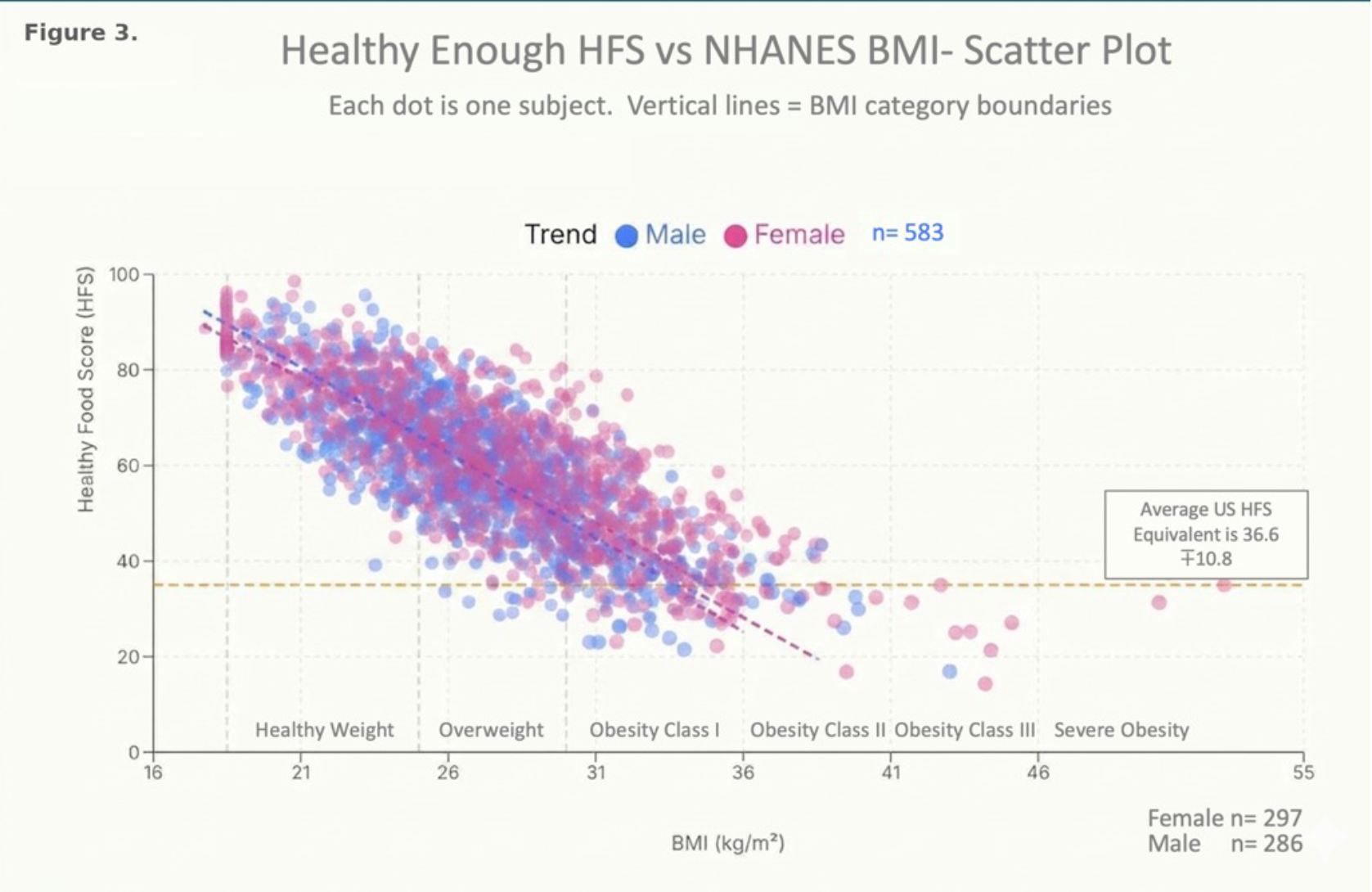
Importantly, the validation of Food Compass should not be interpreted as independent validation of every algorithm, threshold, or clinical outcome associated with HE-Food. HE-Food implemented the Compass algorithm and processed against the same NHANES data for validation with a correlation of r=0.98. An internal study shows the correlation between BMI and HFS shown in Figure 3.
4. The Exercise Adequacy Problem
Nutrition represents only one component of preserving health and function during substantial weight loss.
Exercise is particularly important because dietary protein alone does not provide the mechanical stimulus required to maintain or increase muscle strength and function.
Current literature increasingly emphasizes resistance exercise in conjunction with adequate protein intake during GLP-1–based weight reduction. A recent systematic review and meta-analysis found that lifestyle interventions incorporating resistance training demonstrated more favorable lean-mass preservation than lifestyle intervention without resistance training [2].
Professional guidance similarly recommends integrating progressive resistance exercise into treatment, particularly when substantial weight reduction is occurring [4–7].
Yet exercise recommendations introduce another measurement problem.
Advice such as “exercise regularly” or “do strength training” does not establish:
how frequently the patient exercises;
how long each activity lasts;
whether resistance exercise is actually being performed;
whether aerobic activity is adequate;
whether ordinary movement has declined as body weight decreases;
whether flexibility and balance are being addressed where appropriate; or
whether activity is sustained from week to week.
HE-Move was designed to translate these multiple dimensions of activity into a simplified Healthiness Move Score (HMS) while retaining the underlying information about movement and exercise behavior.
This allows the same conceptual model used for nutrition:
complex underlying behavior → continuous measurement → simplified feedback → longitudinal monitoring
5. The Limitations of Instructions Without Measurement
Traditional counseling remains essential. Patients should receive appropriate guidance from physicians, registered dietitians, exercise professionals, and other qualified caregivers.
The limitation is not necessarily the quality of the instructions.
The limitation is what happens after the patient leaves.
A patient may misunderstand a recommendation, remember it incorrectly, interpret a serving differently than intended, overestimate activity, underestimate food intake, or gradually stop following the recommendation.
Periodic food diaries and 24-hour dietary recalls can provide useful information, but they represent samples of behavior rather than continuous observation. They also depend on memory, reporting accuracy, portion estimation, and patient participation.
GLP-1 therapy can amplify the importance of these limitations because nutritional intake may change substantially as appetite, gastrointestinal tolerance, food preference, and medication dose change.
A treatment model based primarily on giving instructions therefore leaves an important interval between:
recommendation → behavior → next clinical assessment
Digital monitoring has the potential to make part of that interval visible.
6. From Periodic Assessment to Early Intervention
The purpose of collecting nutrition and exercise information should not simply be to create more data.
It should be to identify actionable deviations.
A professional dashboard can convert longitudinal HE-Food and HE-Move data into an exception-monitoring system.
Rather than requiring a clinician or caregiver to manually inspect every meal or exercise session, the system can identify users whose patterns fall outside predefined targets, such as:
Protein intake below target
Overall nutritional quality deteriorating
Selected nutrient intake persistently below reference levels
Strength exercise below target
Overall movement declining
Food or Move scores trending downward
The clinical workflow then changes from:
Give instructions → wait → reassess
to:
Set targets → measure → detect deviation → intervene → reassess

This approach does not replace clinical judgment. Instead, it potentially directs limited professional attention toward patients who appear to need it most.
Recent professional guidance has specifically recognized the potential role of digital platforms, nutritional counseling, adequate protein intake, resistance training, and ongoing monitoring as complementary components of GLP-1 obesity treatment [4].
Whether a particular digital monitoring strategy improves clinical outcomes must ultimately be established prospectively.
7. A Practical Model for GLP-1 Support
The emerging literature suggests that successful obesity pharmacotherapy should increasingly consider not only the magnitude of weight loss but also the quality of that weight loss.
A practical model is:
GLP-1 therapy
↓
Reduced appetite and food intake
↓
Substantial weight loss
↓
Monitor nutritional quality, protein, nutrients, movement and exercise
↓
Identify inadequate intake or activity early
↓
Provide targeted professional intervention
↓
Continue monitoring

The purpose is not to interfere with the appetite-reducing effect of GLP-1 therapy. It is to help ensure that a smaller amount of food remains nutritionally adequate and that weight reduction occurs alongside behaviors intended to preserve strength, function, and long-term health.
This may be particularly important for older adults and others who begin treatment with reduced muscle mass, limited strength, poor diet quality, or other nutritional vulnerabilities.
8. Conclusion
GLP-1–based therapies have made substantial weight reduction achievable for millions of people. Their effectiveness, however, creates a secondary challenge: when patients eat substantially less, clinicians and patients need practical ways to determine whether they are still eating and exercising adequately.
Current evidence supports attention to diet quality, protein intake, micronutrient adequacy, resistance exercise, body composition, and physical function during substantial pharmacologic weight loss. The evidence does not establish that digital monitoring itself prevents muscle loss, nor does it establish a single optimal protein prescription for every GLP-1 user.
Digital tools can, however, address a fundamental measurement problem.
Patients should not have to memorize the nutrient composition of thousands of foods, mentally calculate cumulative nutrient intake, remember several categories of exercise, and accurately reconstruct these behaviors weeks later at a clinical appointment.
These are computational tasks.
HE-Food and HE-Move are designed to perform those calculations continuously, translate complex behavior into understandable scores, and retain the detailed information needed for professional monitoring. A caregiver dashboard can then identify deviations from predetermined nutrition and exercise targets and facilitate earlier intervention.
The resulting model is straightforward:
Measure → Detect → Intervene → Reassess
The next research question is whether this model measurably improves nutritional adequacy, adherence, body composition, strength, physical function, and long-term outcomes among people receiving GLP-1–based therapy.
References
- Look M, Dunn JP, Kushner RF, et al. Body composition changes during weight reduction with tirzepatide in the SURMOUNT-1 study of adults with obesity or overweight. Diabetes Obes Metab. 2025;27(5):2720-2729. doi:10.1111/dom.16275.
- Lean Mass Changes With Incretin Therapy Versus Lifestyle Intervention: A Systematic Review and Meta-Analysis of Randomised Controlled Trials. 2026. PMID: 41877354.
- Changes in food cravings, dietary quality, body composition, and dietary intake during GLP-1 receptor agonist therapy: The CRAVE study. 2026. PMID: 42440974.
- Nutritional priorities to support GLP-1 therapy for obesity: A joint advisory from the American College of Lifestyle Medicine, American Society for Nutrition, Obesity Medicine Association, and The Obesity Society. 2025. PMID: 40673264.
- Nutritional, functional, and psychological considerations for incretin-based therapies in adults: An EASO, EFAD, and ECPO Consensus Statement. 2026. PMID: 42419343.
- Medical nutrition in the glucagon-like peptide-1 (GLP-1) era: Protein strategies, micronutrient monitoring, and lean mass preservation. 2026. PMID: 42036071.
- Optimizing GLP-1 therapies for obesity and diabetes management. 2025. PMID: 41322078.
- Mozaffarian D, El-Abbadi NH, O'Hearn M, et al. Food Compass is a nutrient profiling system using expanded characteristics for assessing healthfulness of foods. Nat Food. 2021;2(10):809-818. doi:10.1038/s43016-021-00381-y.
- O'Hearn M, Erndt-Marino J, Gerber S, et al. Validation of Food Compass with a healthy diet, cardiometabolic health, and mortality among U.S. adults, 1999-2018. Nat Commun. 2022;13:7066. doi:10.1038/s41467-022-34195-8.
- Barrett EM, Shi P, Blumberg JB, et al. Food Compass 2.0 is an improved nutrient profiling system to characterize healthfulness of foods and beverages. Nat Food. 2024;5:911-915. doi:10.1038/s43016-024-01053-3.